

Greek lore boasts epic quests, fearsome gods, and nightmare beasts! Stories about Greek gods and monsters still thrill us today because of their blend of the sinister, mysterious, and instructive. While these Greek mythology creatures often served as antagonists in the quests of heroes, they also embodied the hopes, the dreams, and even the uncontrollable forces of nature that threaten to bring us all to our knees. And now they live on in books, games, and films still!
Ancient Greece was home to some pretty weird, pretty wacky, and seriously scary critters that dared heroes to conquer them. Here are just eight of the coolest Greek mythology monsters:
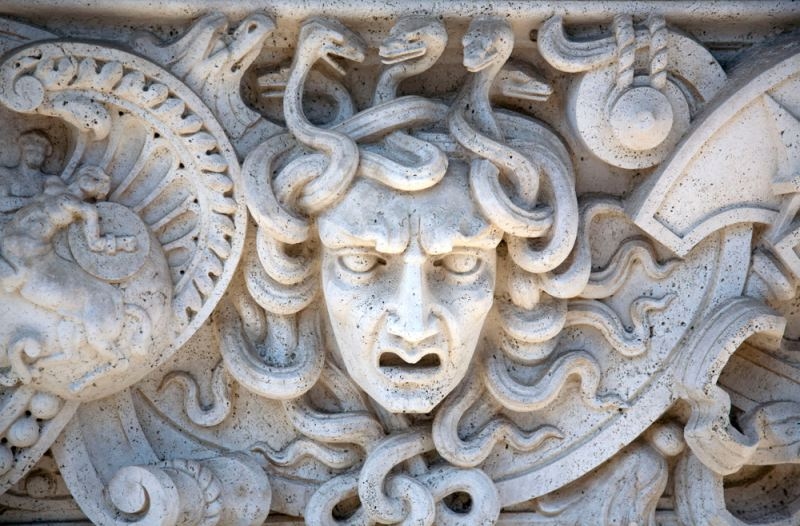
Medusa is probably one of the most recognizable creatures of Greek mythology. Not only did she have hair made of a living colony of venomous snakes, but anyone who dared to make eye contact with her would be turned to stone. Luckily, hero Perseus decapitated her while using a mirrored shield so that he wouldn’t see her terrifying gaze directly. The story remains a cornerstone of Greek myth.
Born with the head of a bull, the body of a man, the minotaur was the only beast to ever live in an elaborate maze constructed on Crete. Built by a famous genius, the labyrinth, a sprawling and confusing maze with many ways in and few ways out of it, guaranteed the minotaur to remain penned.
It would be the hero Theseus who succeeds in slaying the minotaur after a maze-following spree, thanks to Ariadne and her silken string.
Also, a creature from Greek mythology, the Hydra was an enormous water serpent. While she might have made a large water snake, her head counted for two when the heroes took off, only for it to double when it popped back out.
Hero Hercules defeated the Hydra as one of his Twelve Labors by either scorching each of her heads before cutting them off or having his nephew help him do it while cauterizing the open wounds so they couldn’t regenerate. The monster has become emblematic of problems you’d rather not have on your plate, no matter how many you try to put on the table.
Guard dog of the Underworld, Cerberus had three heads to represent birth, life, and death. Otherwise known as the “Hellhound” to those who are translating into modern English, the guarding canine kept the dead from leaving Hades and kept unauthorized beings from entering. Cerberus was not inherently an evil monster, but was one that could become very mean if there was trespassing in the Netherworld.
Imagine one beast made from many parts of multiple animals: that’s a Chimera! Typically pictured having the body of a lion, a goat’s head coming from its back, and the tail of a snake, the beast was fearsome not just in appearance, but also from the fire she breathed down from the sky! The hero who first confronted and slayed this fiery menace on the front lines was the infamous hero Bellerophon, on top of the winged Pegasus.
These mythological creatures look a bit like giant humans, only they have one eye situated in the middle of their face. Some traditions say that Cyclopes were artisans who could forge amazing things in their workshops, and others have made these beings much more evil-intentioned.
The most famous of all Cyclopes is Polyphemus, who captured the hero Odysseus and all of his crew inside a cave before Odysseus managed to fool the beast and put out his only eye to escape.
These mythical beings were renowned throughout the Greek world for their beautiful music and their alluring voices, but those lovely songs were a trap. Attracting ships to steer them towards dangerous rocky shores, Siren songs were deadly for those sailing into them.
On his journey to the sea, Odysseus was able to get past the Sirens by stuffing his sailors’ ears with wax and having himself lashed to the mast of the ship to listen and survive their enchanting melodies. The Sirens represent temptation and the peril of following fleeting desires.
Considered to be the most terrifying monster of all Greek lore and mythology, Typhon was a monstrous dragon-like creature. It was thought that he had the body of an immense dragon, with one of every 100 heads coming out of his body being those of a fiery, man-eating serpent. According to the tales that describe this beast, Typhon engaged in one of the biggest battles in all of Greece against Zeus!
In Greek stories, the gods and monsters worked together many times, whether by curse, divine will, or relationship. It turns out that not all monsters are born monsters: Some are cursed by a god to be an enemy of humankind, others are guardian beasts put in place to protect sacred sites, and even some gods themselves turn into animals or creatures! In a nutshell, some of these were born out of the wrath of the gods or put there by them to challenge heroes.
The timeless allure of legendary animals arises because of their symbolism. In ancient Greek mythology, monsters, from Medusa to Typhon, would either embody people's worst fears (such as meddling with taboo sexual or physical relations) or pose moral dilemmas. In many Greek myths, a monster would test a hero’s will and force him to come out as a better and stronger individual after being tested.
Their stories provide insight into our character, our strengths and weaknesses, what's right and wrong, and most importantly, how we overcome and succeed. All of these timeless themes allow the legendary creatures to remain popular and entertaining, and are the basis of much of today's media, such as novels, books, and movies!
Greek mythology monsters’ stories still draw audiences’ interest because they blend exhilarating adventures and profound lessons together. The Greek monsters from Medusa and the Minotaur to Hydra and Typhon are the reason for many well-known ancient stories. With all these stories being passed down, we can see that legends, powerful symbols, and remarkable monsters will never go out of style.
Typhon is generally considered one of the greatest Greek monsters. He was the monstrous being capable of the strength to compete with Zeus as well as have considerable influence with the gods, and he was considered to be a greater threat to the Greek people than almost any other creature.
Not entirely, for many creatures of Greek myth were bizarre combinations of various animals or part man/part animal. However, Greek mythology draws heavily on creatures from other cultures, which could be a reflection of real creatures or at least fears associated with real creatures.
Heroes generally had to combat mythical monsters in an attempt to rescue people, obtain something (a sacred item, for instance), or prove their worth as heroes through their acts of courage, intellect, and determination. These trials helped heroes to grow into truly great individuals.
You may not believe it, but these stories have come back to the 21st Century; numerous ancient myths and stories have inspired our books, television shows, games, and movies today. Many characters, stories, or creatures used today still draw much of their inspiration from these ancient texts, giving us the entertainment that we can still find popular, enjoyable, and in some cases, inspirational.
This content was created by AI